
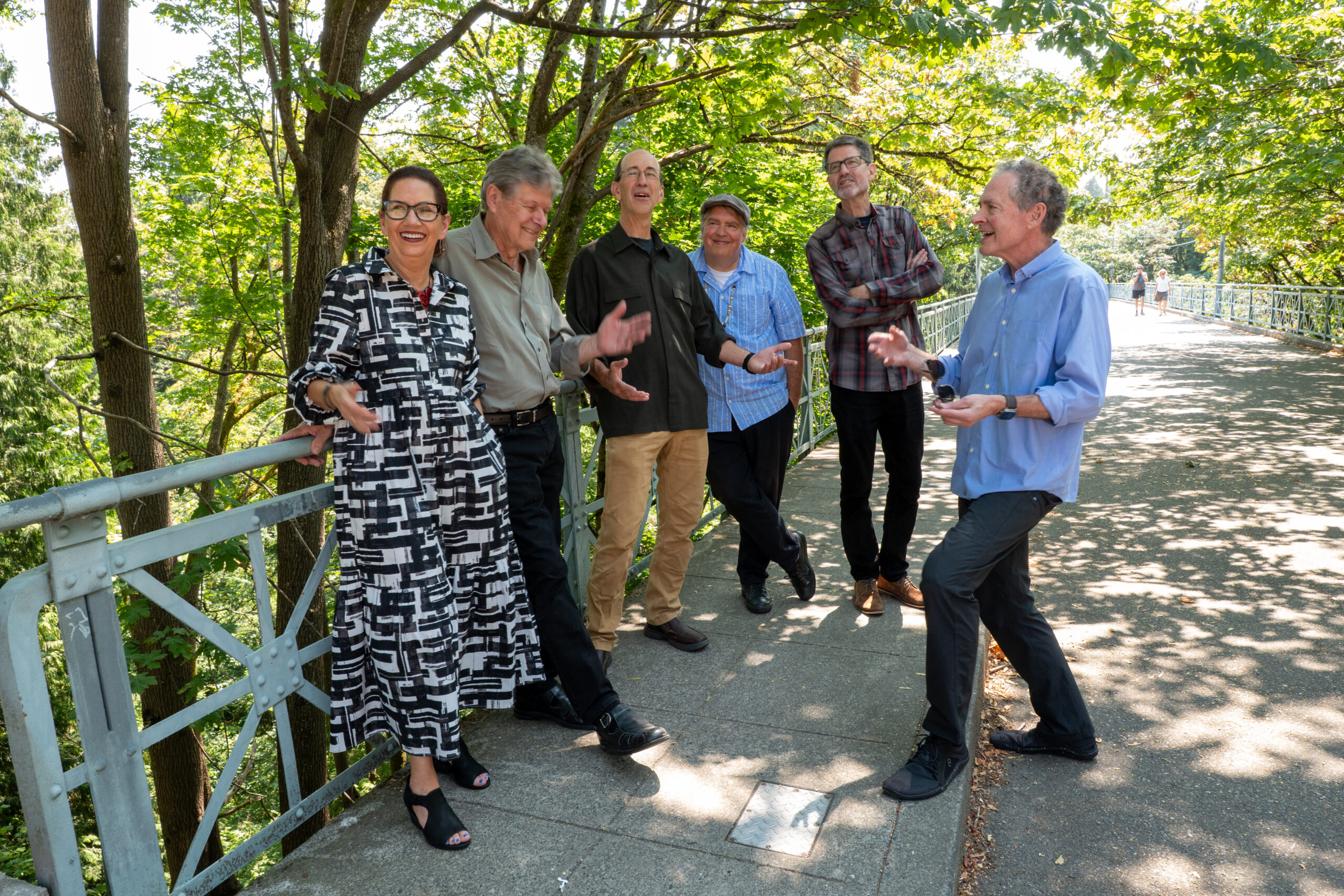
Forman and Finley Band featuring Cherrie Adams

Music
We seek to explore the creation of heartfelt musical ideas in a strongly interactive way. By creating space and listening carefully, we seek the surprise of beauty, humor and warmth.
Paul and I started out as a duet 25 years ago. Thirteen years ago a band was formed. Cherrie Adams (Vocals), Rick Leppanen (Bass), Jeff Busch (Drums), and Clif Swiggett (Trombone and Percussion)
Click here to visit our music site to find out more and listen to two full albums.
Click here to go to my travel site to see about 100 vignettes and photos from 40 years
But first, my ambivalence with tourism
I have devoted a cumulative three years of the last 40 to travel. 60 trips. Some were with my children, family, and friends. But most were by myself. My travel posts are short vignettes of experiences.
Some of the places I have loved most in the world are places that nobody particularly recommends visiting. Korçë, Albania. Zugdidi, Georgia. Ambato, Ecuador. Temuco, Chile. Even a much larger city like Diyarbakır, in southeastern Turkey is not really looked at. These are places where I can arrive on a bus, find a modest hotel, and spend an entire day walking around without doing anything that could reasonably be called sightseeing.
I have been trying to understand why this gives me so much pleasure.
It isn’t the satisfaction of discovering somewhere that other travelers have overlooked. I have no interest in claiming a place as my own little secret. Nor is it a search for the exotic, for dramatic poverty, or for picturesque people living lives that seem untouched by the modern world. Quite the opposite. What attracts me is the ordinary business of life, carried on in places where the ordinary looks just different enough to make me notice it.
I love streets filled with businesses that exist because the people who live there need them. Hardware stores, pharmacies, bakeries, clothing shops, cellphone repair counters, stationery stores, furniture stores. Shops selling things I don’t recognize, next to shops selling things I recognize immediately. A restaurant that serves lunch to people on their lunch breaks. A bus station that is simply a bus station, not an adventure in local color. People going to work, buying something for dinner, meeting friends, looking at their phones, getting on with their day.
There is something wonderful about being surrounded by a society that is completely occupied with itself.
Of course these places are different from home. The buildings have different proportions, the sidewalks are laid out differently, the shops have unfamiliar names, and the public spaces reflect local habits I don’t entirely understand. But these differences are rarely spectacular. They accumulate quietly. After a few hours of walking, I begin to sense the particular rhythm of the place. Its scale, its commercial life, its small aesthetic choices, its habits of sociability. I am watching an entire city solve the same everyday problems that people solve everywhere, but in its own way.
And perhaps that is what fascinates me: the endless variety of normal life.
I don’t particularly want to see wealth displayed as spectacle, where every storefront is a boutique, a luxury hotel, or an expensive restaurant. But neither do I want to make an attraction out of deprivation. There is nothing admirable about poverty simply because it looks unfamiliar to someone passing through. What interests me is the broad, complicated middle of human existence. People with jobs, ambitions, routines, frustrations, families, and errands. People living ordinary lives in cities that have evolved around their needs rather than around the expectations of visitors.
Which may explain why I never want to go again to a place like Venice. It is unquestionably beautiful. But so much of its historic centers seem organized around being looked at. The shops, restaurants, and streets increasingly serve an audience that has come to admire the city. I know there is a real Venice, where people live ordinary lives. And I have found it. But the celebrated part can feel like a magnificent stage set, with visitors playing the leading roles.
In Korçë or Zugdidi, I feel something almost opposite. Nobody has arranged any aspect of the city for my benefit. Nobody needs me to find it charming. A perfectly unremarkable commercial street can be more interesting to me than a famous monument, precisely because it is not trying to be interesting.
There is also a special kind of freedom in being anonymous in these places. I have no itinerary to fulfill, no obligatory attraction to visit, no anxiety that I might be missing the thing everybody came to see. I can turn left because a street looks inviting, walk ten blocks, sit down for coffee, and watch the afternoon unfold. I don’t need to accomplish anything. The pleasure is simply in being there.
What makes this kind of travel so satisfying is not that I am witnessing something extraordinary. It is that I am seeing something profoundly familiar expressed through a different history, geography, economy, and culture. The similarities are as interesting as the differences. People everywhere need shoes, vegetables, haircuts, transportation, furniture, companionship, and a place to sit in the afternoon. Yet there are a thousand ways to arrange a city around these simple requirements.
Perhaps I am drawn to places where life has not been turned into a presentation of itself. Places that are neither performing prosperity nor being observed through the lens of hardship. Places that are simply getting on with being places.
I can spend hours walking through these cities and return to my hotel feeling that I have had a wonderful day, even though I would have considerable trouble telling anyone what I did.
And maybe that is the best explanation of all. I travel halfway around the world not always to see something remarkable, but to discover how remarkable the unremarkable can be.